
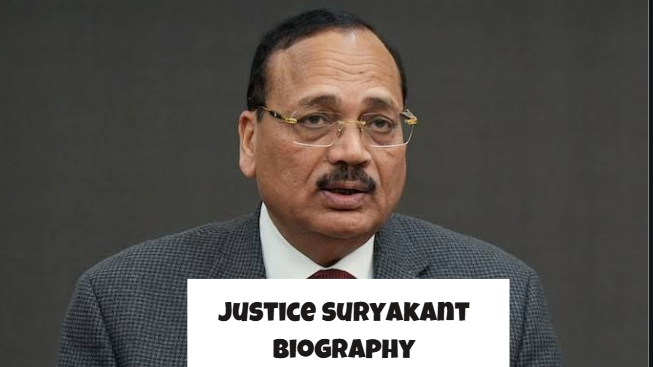

| Field | Details |
|---|---|
| Full name | Surya Kant |
| Born | 10 February 1962, Petwar village, Hisar district, Haryana. |
| Religion | Hindu |
| Father | Shri Madan Gopal Sharma (Sanskrit teacher) — passed away in October 2018. |
| Mother | Not publicly disclosed |
| Wife | Savita Vashisht |
| Key positions | Judge, Punjab & Haryana HC; Chief Justice, Himachal Pradesh HC; Judge, Supreme Court; 53rd Chief Justice of India (took oath Nov 24, 2025). |
| Retirement | Scheduled for 9 February 2027 (on attaining age 65) |
Justice Surya Kant Biography
Justice Surya Kant’s journey from a small village in Haryana to the highest judicial office in India is a study in persistence, discipline and legal scholarship. Known for judgments on constitutional matters, citizens’ rights, and several high-profile benches, he has entered national prominence not only for his rulings but for his clear focus on reducing court backlogs and strengthening dispute-resolution mechanisms. This biography explores his family background, education, personal life, notable career milestones, and some context about his priorities as Chief Justice.
Early life and family background
Surya Kant was born on 10 February 1962 in Petwar, a village in Hisar district of Haryana. He grew up in a modest, middle-class household where education was emphasized. His father, Shri Madan Gopal Sharma, was a Sanskrit teacher whose commitment to learning influenced young Surya’s formative years. Details about his mother are not publicly disclosed, but sources describe a family environment that prized study and hard work. His upbringing in rural Haryana helped shape a work ethic that later guided his legal career.
In October 2018, Surya Kant’s father passed away; local and state records and press reports at the time carried tributes noting his role as a respected teacher in the community. The judge has occasionally referenced his roots and the value of education in public speeches.
Education
Surya Kant’s academic record is notable for steady advancement and excellence. He completed his law degree (LLB) from Maharishi Dayanand University, Rohtak, and later pursued a Master of Laws (LLM) through Kurukshetra University’s distance education program, where he secured top marks — standing ‘first class first’ in his LLM batch. His academic success, even while balancing professional responsibilities, is often highlighted as part of his disciplined approach to the law.
Personal life — wife and religion
Surya Kant is married to Savita Vashisht. Public profiles and media coverage consistently describe him as a private family man who keeps his domestic life away from the limelight. He follows Hindu religious traditions, a fact noted in public biographical summaries and media profiles.
Legal career — rise from advocacy to the Supreme Court
Surya Kant began his legal career as an advocate in Haryana, eventually becoming Advocate General of Haryana — a post that established his reputation for competence in constitutional and administrative law. He was designated as a senior advocate and later elevated to the bench of the Punjab & Haryana High Court as a permanent judge in January 2004. Over the years he handled a variety of constitutional, civil and criminal matters, building a portfolio of reasoned judgments.
In October 2018, he was appointed Chief Justice of the Himachal Pradesh High Court — a move that, while routine in judicial career terms, was the subject of contemporary media attention because an earlier letter from a sitting Supreme Court judge had raised objections to his elevation (the Collegium proceeded with the recommendation). Shortly after, in May 2019 he was elevated to the Supreme Court of India, where he became part of several important benches.
Notable judgments and judicial approach
As a Supreme Court judge, Justice Surya Kant has been associated with decisions spanning constitutional law, civil liberties, electoral accountability and institutional transparency. Highlights of cases and directions associated with benches he was part of include:
-
Participation in benches on the abrogation and legal aspects of Article 370 and related constitutional challenges.
-
Playing a role in keeping the colonial-era sedition law in abeyance to allow government review — reflecting a balance between enforcement and civil liberties.
-
Directing administrative action toward greater transparency in electoral rolls — nudging the Election Commission to disclose details related to voter exclusions in Bihar.
-
Ordering reservation of one-third seats in bar association leadership positions for women in some associations, signaling a push for gender parity in legal institutions.
-
Being part of the Pegasus spyware-related hearings, where the bench emphasized that national security cannot automatically override individual rights and that expert enquiry is sometimes necessary.
Justice Kant’s jurisprudence is widely characterized by careful reasoning, an emphasis on institutional mechanisms (like mediation) to reduce litigation, and a pragmatic bent toward reducing pendency. His experience across state high courts and the Supreme Court has given him a broad view of systemic challenges.
Appointment as Chief Justice of India and priorities
On 24 November 2025, Justice Surya Kant took oath as the 53rd Chief Justice of India. His tenure is expected to last until he reaches the retirement age of 65 — scheduled for 9 February 2027. Observers note his immediate stated priorities include reducing the Supreme Court’s pendency and promoting mediation and other case-management techniques to speed up dispute resolution. He has publicly flagged the backlog: the Supreme Court docket had crossed around 90,000 pending matters, which he listed as a principal challenge to be tackled during his time as CJI.
Controversies and scrutiny
Like many figures who rise to the top of a national institution, Justice Surya Kant’s career saw scrutiny. For example, objections raised by a then-Supreme Court judge in the context of his elevation to a high court were reported in the national press; however, the Collegium proceeded with the transfer and elevation and he was later appointed to the Supreme Court. Media coverage at the time debated the process and the Collegium’s decisions, but subsequent events and his judicial record shaped the broader public view.
What makes his tenure notable?
-
Administrative focus: He has stressed case-management reforms and mediation as tools to reduce backlog
-
Balanced jurisprudence: His benches have delivered judgments that balance state interests with individual rights (e.g., sedition law abeyance, privacy and surveillance hearings).
-
Institutional reforms: Direction toward gender representation in bar bodies and appointment of fact-finding or expert panels in complex matters indicate an inclination toward procedural reform and inclusivity
FAQs (Frequently Asked Questions)
Q1: What is Justice Surya Kant’s full name?
A1: His full name is Surya Kant; official profiles and court records list him simply as Surya Kant.
Q2: When was Justice Surya Kant born and where?
A2: He was born on 10 February 1962 in Petwar village, Hisar district, Haryana
Q3: Who are Justice Surya Kant’s parents?
A3: His father was Shri Madan Gopal Sharma, a Sanskrit teacher who passed away in October 2018. His mother’s details are not widely publicized.
Q4: Who is Justice Surya Kant married to?
A4: He is married to Savita Vashisht.
Q5: When does he retire as Chief Justice?
A5: Justice Surya Kant is scheduled to retire on 9 February 2027 upon attaining the age of 65.
Q6: What will be his main priority as Chief Justice?
A6: He has publicly prioritized reducing the Supreme Court’s backlog of pending cases — the docket crossed roughly 90,000 matters — and promoting mediation and improved case-management.
Conclusion
Justice Surya Kant’s life story — from a Haryana village to the Chief Justice’s chair — is anchored in steady study, legal rigor, and a clear administrative vision. As CJI, he inherits the twin tasks of preserving constitutional democracy through sound judgments and improving the system’s efficiency so justice reaches citizens faster. His focus on arrears, mediation, and inclusive institutional reforms will shape his legacy in the months leading up to his retirement in February 2027. For readers interested in India’s judiciary, his tenure is likely to be closely watched for procedural reforms and its impact on major constitutional law developments
